How Long Should a Delivery Driver Wait for an Order?
Waiting at a store may not add miles, but it can reduce your hourly profit. Learn how to decide when an order is still worth completing.
By Thomas Staggs · August 31, 2026
How Long Should a Delivery Driver Wait for an Order?
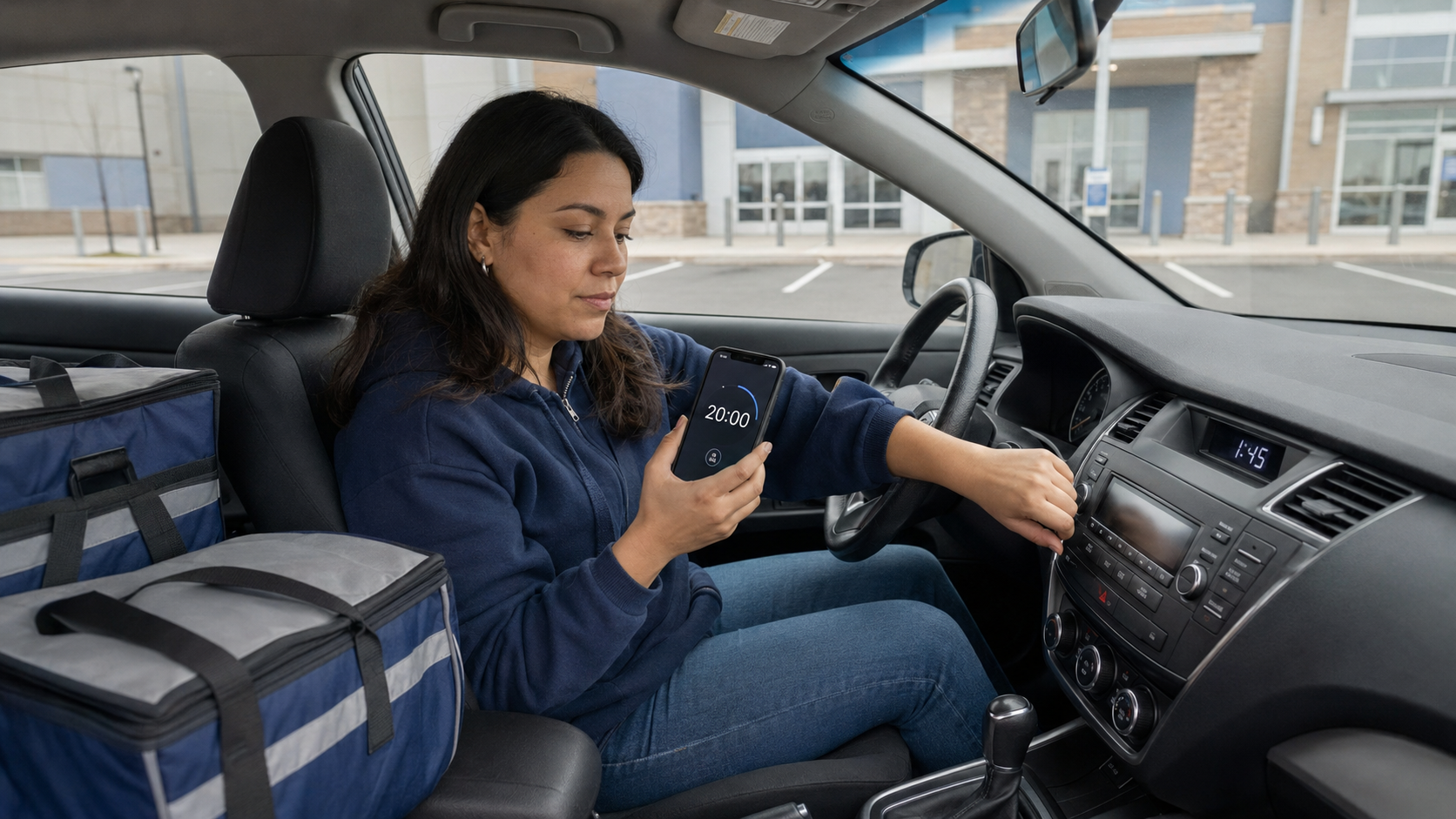
You accept an offer that appears to pay well for the mileage. You arrive at the store, check in, and wait.
Five minutes pass. Then 10. Then 20.
The payout has not changed, but the value of the delivery has.
Waiting may not use much gas or add many miles, but your time still has value. Every extra minute lowers your potential hourly profit and keeps you from completing another order.
So, how long should a delivery driver wait?
There is no single answer that works for every order. Drivers should consider the payout, mileage, expected delivery time, store conditions, cancellation rules, and the likelihood that the order will be ready soon.
Waiting time is part of the trip
Many drivers begin judging an offer by looking at the payout and displayed mileage. Time can be harder to estimate.
An offer may appear profitable when you expect it to take 30 minutes. If a store delay pushes the trip to 50 minutes or an hour, your profit per hour can change quickly.
Waiting time should be included in the total time required to complete the delivery.
The trip begins when you commit your time and vehicle to the order. It does not begin only when the order is loaded into your car.
How waiting changes hourly pay
Suppose you accept an $18 offer that you expect to complete in 30 minutes.
At 30 minutes, the offer produces a gross rate of:
$18 ÷ 0.5 hours = $36 per hour before expenses
Now suppose you wait an additional 20 minutes. The complete order takes 50 minutes.
Your gross hourly rate falls to:
$18 ÷ 0.83 hours = about $21.69 per hour before expenses
If the order takes a full hour, the gross rate becomes $18 per hour before fuel, vehicle costs, and taxes.
The payout stayed at $18. The extra time reduced the offer’s value.
Is 10 minutes too long to wait?
A 10-minute wait will not automatically make every offer unprofitable.
A short delay may be reasonable when:
- The payout is strong
- The mileage is low
- The order is nearly ready
- The delivery ends in a useful area
- The store normally loads orders quickly
- Canceling would create another unpaid delay
- You have already invested time and miles reaching the store
The important question is whether the complete trip can still meet your profit goals.
A $30 order may be able to absorb a 10-minute delay more easily than an $8 order. The same waiting time can have a different effect depending on the original offer.
When a 20-minute wait becomes a problem
Once a wait reaches 20 minutes, drivers should recalculate the offer instead of relying on the original estimate.
Ask yourself:
- How long have I already waited?
- Has the store provided a realistic update?
- How much longer could loading take?
- How much driving and delivery time remains?
- What will my hourly rate be if I continue?
- Could canceling affect my account or performance measurements?
- Am I likely to receive another worthwhile offer soon?
Do not look only at the time already spent. Consider the time still required to finish.
If you have waited 20 minutes but the order is being brought to your car, completing it may still be the best choice. If employees cannot locate the order and cannot estimate when it will be ready, the delay may continue much longer.
Avoid the sunk-cost trap
After waiting for an order, it is natural to think, “I have already spent this much time, so I might as well finish.”
The time you have already spent cannot be recovered. Your decision should focus on what happens next.
Suppose you have waited 25 minutes. The store says the order will probably require another 30 minutes.
The question is not whether you want to waste the first 25 minutes. Those minutes are already gone.
The question is whether the remaining payout is worth another 30 minutes of waiting plus the drive and delivery.
Continuing may still be the correct decision, but it should be based on the remaining time and expected profit.
Store updates matter
A useful update can change your decision.
“There are two cars ahead of you, and your order is ready” provides more information than “It should be out soon.”
Before leaving, politely ask whether the order is ready and whether the store can provide a realistic estimate. Employees may be dealing with staffing problems, missing items, technical issues, or an unusually large number of orders.
The purpose is not to pressure store employees. It is to get enough information to make a better decision.
Know the platform’s cancellation rules
Before canceling or dropping an accepted order, check the current rules for the platform you are using.
Policies can differ between services and may change over time. Canceling an order could affect completion measurements, access to incentives, account standing, or other performance records.
Some platforms may treat a store delay differently from a driver canceling without a documented problem. Follow the steps inside the driver app and select the most accurate reason when reporting a delay.
Protecting your time is important, but so is protecting your account.
Set a personal waiting limit
A personal waiting limit gives you a point at which you stop and reevaluate the order.
It does not have to mean that you automatically cancel when the timer reaches a certain number. It means you perform a new calculation using the information available at that moment.
For example, you might decide:
- At 10 minutes, check the order’s status
- At 15 minutes, recalculate the expected hourly profit
- At 20 minutes, ask for a realistic completion estimate
- After 20 minutes, continue only if the remaining trip still meets your goals
Your limit may change depending on the payout, time of day, store, order size, and delivery location.
The goal is to create a deliberate decision point before an open-ended wait consumes an hour.
Track which stores regularly cause delays
One slow order may be unusual. Repeated delays reveal a pattern.
Keep private notes about:
- The store location
- The day and time
- How long you waited
- Whether the delay was communicated
- The original payout
- The total time required
- Your final profit per hour
After several trips, you may discover that a store is usually fast in the morning but slow in the evening. Another location may have long waits on weekends or during holidays.
This information can help you estimate future offers more accurately.
An $18 offer from a consistently slow store should not be judged the same way as an $18 offer from a location that normally loads orders quickly.
Include waiting in your offer decisions
You cannot predict every delay before accepting an order, but you can use your experience to make a reasonable estimate.
If a store regularly adds 20 minutes to every pickup, include that time when reviewing future offers from that location.
Instead of estimating only the driving time, consider:
Pickup wait + driving time + drop-off time + likely return time = complete trip time
This gives you a more realistic picture of the work required.
Waiting affects more than hourly pay
Store delays can also affect:
- Incentive progress
- Scheduled commitments
- Multi-order opportunities
- Your ability to work during busy hours
- Fuel used while idling
- Stress and fatigue
- The time available for your next offer
A driver may accept a weak order to complete an incentive, only to lose so much time waiting that there is no opportunity to finish the remaining trips.
Look at the entire effect of the delay, not only the current payout.
Frequently asked questions
How long is too long for a delivery driver to wait?
There is no universal limit. A wait becomes too long when the expected payout and remaining work no longer meet your profit goals or when continuing creates an unacceptable risk to your schedule. Platform cancellation rules should also be considered.
Should I cancel after waiting 20 minutes?
Not automatically. Recalculate the complete trip and ask whether the order is nearly ready. Also review the platform’s current cancellation rules before making a decision.
Does waiting count as working time for a delivery driver?
Waiting is part of the time you commit to completing the order. Even if it does not add mileage, it affects how much you earn per hour.
Can a high-paying order still be unprofitable because of waiting?
Yes. A large payout can lose value when a long store delay, difficult delivery, high mileage, and vehicle expenses are included.
How can delivery drivers prepare for store delays?
Track your wait times by location and time of day. Use those patterns when estimating future offers and set a point at which you will reevaluate a delayed order.
The bottom line
There is no perfect number of minutes every driver should wait.
A short delay may be reasonable for a strong offer. The same delay could make a low-paying order no longer worth completing.
Track the total time, ask for a realistic update, recalculate the remaining value, and follow the platform’s cancellation rules.
Waiting does not always add miles, but it always uses time. Your time must be included when deciding whether an offer protects your TRUE profit.